From Policy to the Field: Why Low-Carbon Projects Struggle to Secure Financing
Author : ICSP (SSH)
Note :
CONFERENCE HIGHLIGHTS
The 11th Sustainability Practitioner Conference (SPC) 2026 – “Driving Just Transition: From Strategy to Real Impact”
Session : Executive Dialogue: “Financing the Just Transition: Aligning Capital with Climate & Social Goals”
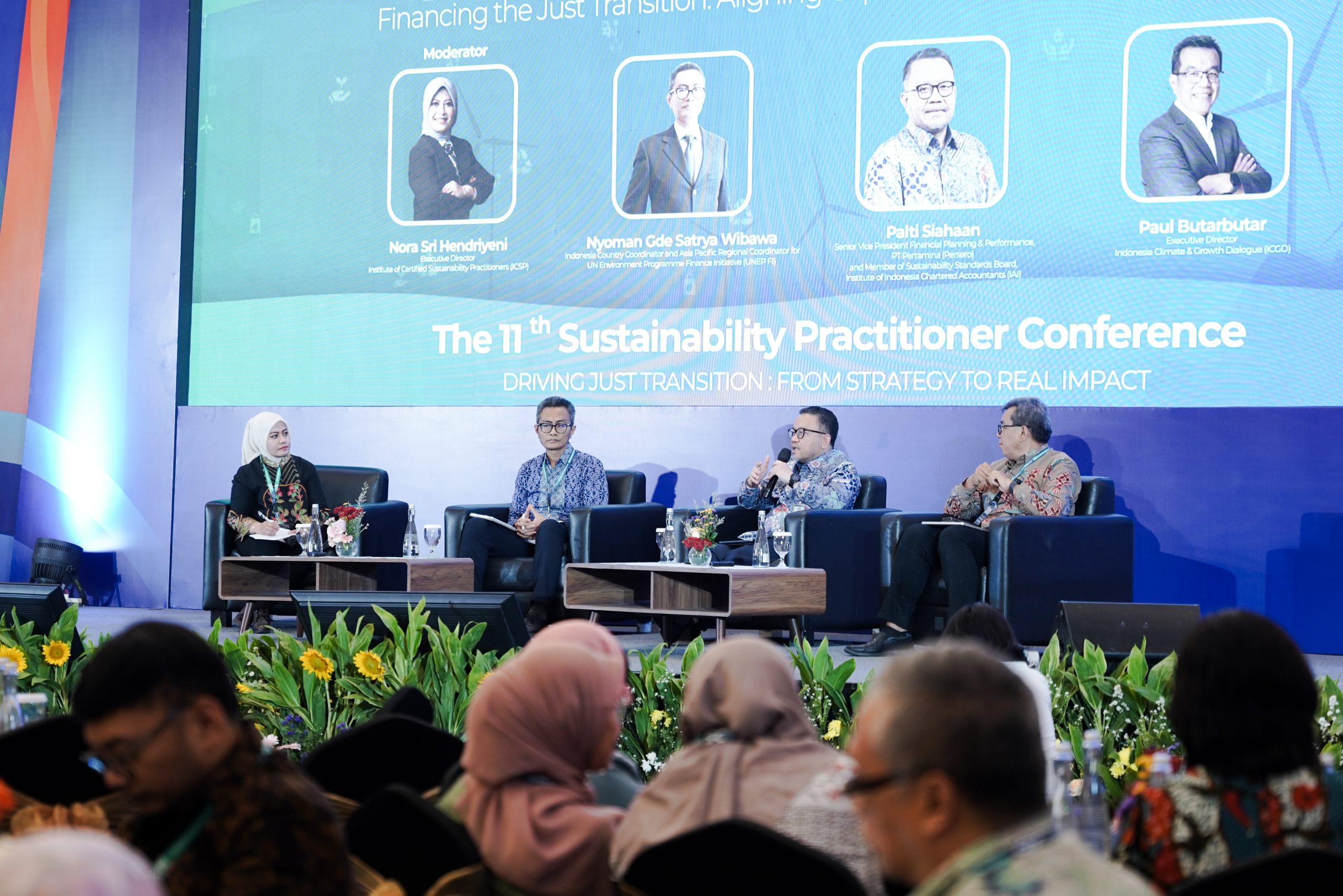
The discussion began with the role of financial institutions as conduits of capital. Global principles and initiatives encourage banks and insurance companies to align their operations, governance, and organizational culture with national climate commitments and the Paris Agreement, select priority impact areas, and then set measurable targets. Climate issues are also increasingly linked with nature, the inclusive economy, and human rights because all are interrelated.
From the perspective of climate finance practice, Executive Director of the Indonesia Climate & Growth Dialogue (ICGD), Paul Butarbutar, who previously led the Just Energy Transition Partnership (JETP) Secretariat, considers Indonesia’s policy ecosystem relatively ready. The most critical gap, in his view, lies in translating policy into implementation on the ground.
“In my view, the Government has already prepared a great deal at the policy level; our policies may well be among the most comprehensive. Incentives are in place, and so on. But what has always been our problem is how to convert policy at the policy level into the operational level,” said Paul.
That gap is visible in the small number of projects that are ready for financing. Of the JETP commitment of approximately USD 21 billion, less than USD 4 billion has become investment, while geothermal potential has been converted to only about 1–2 gigawatts out of approximately 27 gigawatts. Obstacles include procurement and power purchase agreements that carry risk, as well as a high cost of funds, with US dollar loans for renewable energy cited at around 8–9%. According to Paul, regulations that are long-term and do not change constantly would reduce risk, because uncertainty drives up the cost of building power plants (EPC; engineering, procurement, and construction).
However, funding does not always have to come from the Government. Paul cited the capture of flare gas at oil and gas facilities, which is processed into dry gas, LPG, and condensate, with third-party investment recovered through the sale of carbon credits. The use of waste gas as fuel is also already under way at a number of facilities, showing that creative approaches can open new sources of funding.
From the financial sector’s perspective, the needs that emerged were harmonization of policy among regulators, a uniform classification of sustainability activities, and stronger incentives because non-fiscal instruments alone are limited. Banks also hope for regulatory encouragement that is applied evenly so that not only large banks are directed, while real-sector business actors often wait for obligations before acting. A sustainable finance roadmap currently being prepared is expected to serve as a means of coordination.
Financing approaches are also beginning to combine banking, insurance, and blended finance, among other things to protect MSMEs that rely on credit and are vulnerable to extreme weather. On the fairness side, companies that change their business direction need to consider human resource reallocation, upskilling, and efforts to minimize layoffs, while young people and civil society can contribute through public education and oversight of the social aspects of projects.
In the same discussion, Senior Vice President Financial Planning & Performance at PT Pertamina (Persero) and also a Member of the Sustainability Standards Board (DSK) of the Institute of Indonesia Chartered Accountants (IAI), Palti Ferdico TH Siahaan, said that financial viability is key. He considers that cheaper bank financing for green projects will be effective only if shareholders also accept lower minimum returns, while certainty of the buyer through policy, such as the obligation to blend biodiesel based on FAME (fatty acid methyl ester) and the plan to blend ethanol, helps projects become bankable. Such policies also encourage companies to adjust their strategies, including by strengthening petrochemicals and exploring bio-based feedstocks.
However, industry needs harmonized policy in Indonesia. According to Palti, without balancing policies such as a carbon tax, change will proceed slowly because companies that switch do not gain an economic advantage over those that do not. He also warned of the potential for greenflation, that is, rising mineral prices when many parties shift to clean energy, which could make the economy more expensive.
“No party can achieve this goal from the corporate side alone. From the regulator’s side, support is also essential for it to become economical. So it is not only about financing the transition, but about how that transition itself can be financeable,” said Palti.
To that end, he highlighted the challenge of cascading national targets into company targets when the ecosystem is not yet binding. According to him, financial statements are mandated by law and accompanied by sanctions, whereas PSPK 1 and 2, national standards that adopt IFRS S1 and S2, are currently still voluntary and scheduled to take effect on 1 January 2027. As a result, companies now prepare their own scenario analyses, whereas national goals would ideally be translated through national scenarios for each industry.
“Just transition should not be viewed in binary terms of fossil versus renewable energy. Ultimately, the question is how investments in renewable or low-carbon energy can at least reach minimum break-even [the point at which returns cover costs], because, after all, we need funding. If the NPV [net present value] is negative and the IRR [internal rate of return] is below the hurdle rate [the minimum required rate of return], this would certainly not be bankable to finance,” said Palti.
This article is a CONFERENCE HIGHLIGHTS piece from The 11th Sustainability Practitioner Conference (SPC) 2026, “Driving Just Transition: From Strategy to Real Impact,” covering specifically the Executive Dialogue: “Financing the Just Transition: Aligning Capital with Climate & Social Goals” session.
This article is available in both English and Bahasa Indonesia. The Bahasa Indonesia version is provided to facilitate access for Indonesian readers.
Download the Indonesian Translation
Categorised in Media, Sustainability News & Updates. Submitted by ICSP Editor