Challenges of a Just Transition in Indonesia: Large Funding Needs, but Projects Not Yet Ready for Financing
Author : ICSP (SSH)
Note :
CONFERENCE HIGHLIGHTS
The 11th Sustainability Practitioner Conference (SPC) 2026 – “Driving Just Transition: From Strategy to Real Impact”
Session : Panel Discussion – “Policy, Regulation & Industry Leadership in Driving Just Transition”
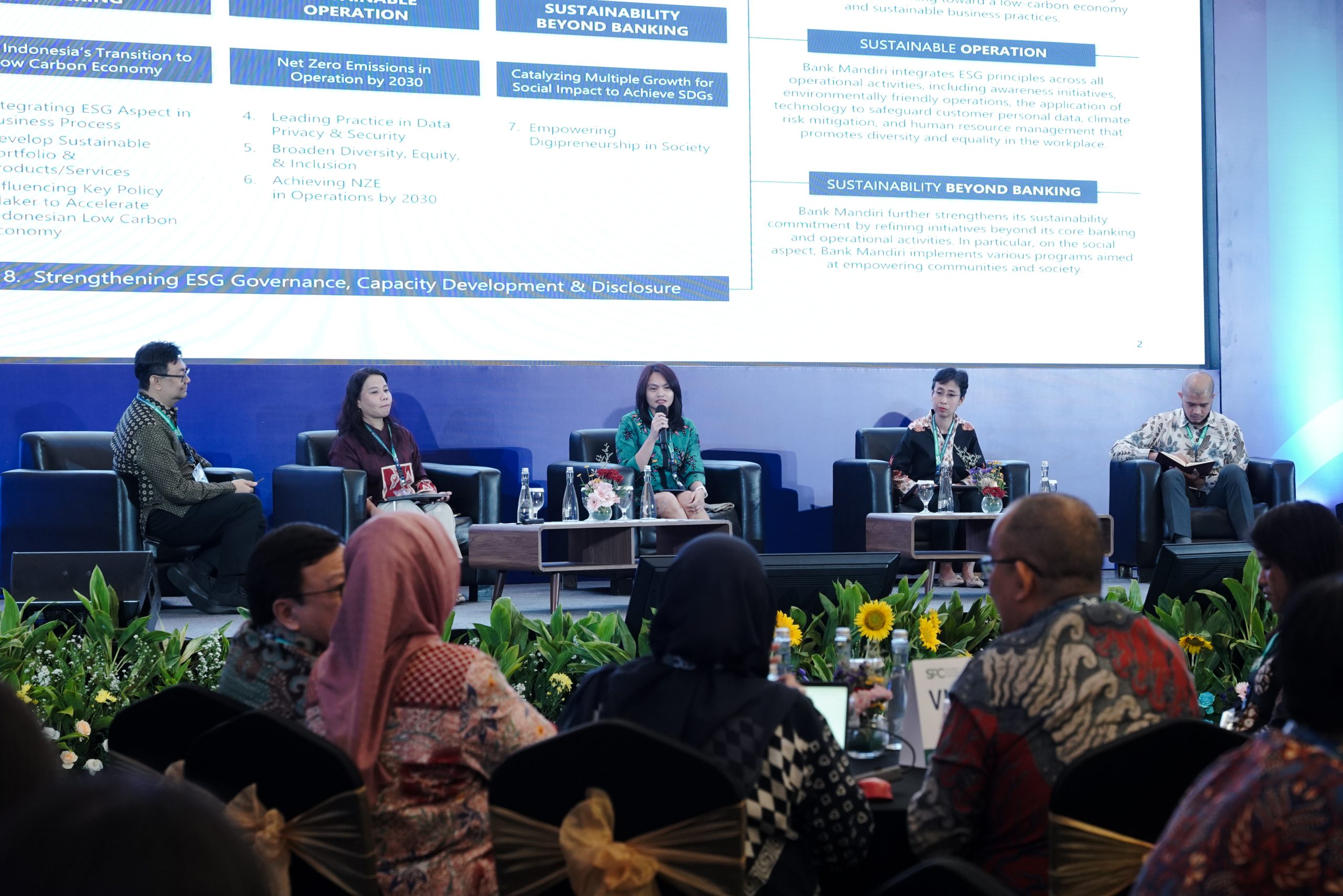
The scale of financing needs was the starting point of the discussion. Advisor to the Director General for State Asset Optimization Affair at the Ministry of Finance of the Republic of Indonesia, Nella Sri Hendriyetty, explained that Indonesia’s second climate target (Second NDC) requires investment of approximately USD 472.6 billion over 2031–2035, with around 75.8% of it for the energy sector. Public funding over 2016–2023 covered only about 7.7% of that need. For this reason, the Government does not position itself as the sole financier.
“The question is how the regulations being prepared can crowd in investment. Fundamentally, the Government is drawing in private and international funds so that they can come in. From there, we hope for lower emissions, a resilient economy, growth that is enjoyed by all segments of Indonesia’s population, and cleaner air,” said Nella.
The discussion also brought out that banks serve as catalysts for capital mobilization, but capital does not flow automatically. Projects that are not yet ready for financing, long tenors, and risks that have not yet been allocated remain obstacles, so blended finance and guarantee schemes continue to be explored. Price incentives for green financing are also not yet significant, so additional policy support is still needed.
However, funds and ready projects alone are not enough. The transition also affects the people within it, such as workers and regions that have long depended on coal. Nella cited approximately 30,000–35,000 coal-fired power plant workers, not including the contractors, suppliers, and service providers around them, who would be affected when plants are retired. Social protection and new skills training therefore need to be prepared early.
“What is central to the structure of our just transition is how ready our society is to support it. Because if society is not ready, investment will not come in either,” said Nella.
Practice at the company level was illustrated by the experience of the energy industry. Corporate Climate Change & Energy Transition Manager at PT Medco Energi Internasional Tbk, Agustina Parwitosari, said that the transition in upstream oil and gas is carried out in a phased and responsible manner. The company targets net zero for Scope 1 and 2 by 2050 and for Scope 3 by 2060, with 2025 interim targets that, according to her, have been achieved.
“Just transition is, of course, not merely a sustainability commitment, but also about maintaining the continuity of the business over the long term,” said Agustina. According to her, a just transition plan helps the company respond to investor and public expectations, prepare its workforce, and maintain its social license to operate. “In essence, this is an investment, but a long-term investment that should create value for the company.”
The company also uses reporting as a means of accountability: its sustainability report is third-party assured and presents both achievements and shortcomings, while climate reporting is submitted through CDP. Agustina considers that transparency drives real action, because commitments already made public create a responsibility to honor them. Asked about concerns that the transition could become mere transition washing, she acknowledged that the just transition plan has not yet been assured because it was only launched in 2025 and measurable KPIs are still being developed. Some implementation is already under way, and assurance will follow gradually.
A broader partnership also supports these efforts, one of which is the Just Energy Transition Partnership (JETP), a collaboration between the Government of Indonesia and international partners launched at the 2022 G20 Bali Summit. Within it, the Just Transition Framework was formulated in 2023–2024 with nine standards. Eight standards ensure that no party is harmed, while the ninth, on economic diversification and transformation, ensures that communities around projects also enjoy the benefits.
Its implementation rests on four pillars: continually strengthened regulation; financing; partnerships with communities through existing mechanisms such as Musrenbang (development planning consultation forums); and governance that involves local and central governments in monitoring, not only companies. Local governments need to be involved from the outset because many of residents’ expectations concern the duties of local governments. Ultimately, the measure of a successful just transition is not a compliance checklist, but a shared commitment by policy, finance, and industry to build a resilient local economy before the next project even breaks ground.
This article is a CONFERENCE HIGHLIGHTS piece from The 11th Sustainability Practitioner Conference (SPC) 2026, “Driving Just Transition: From Strategy to Real Impact,” covering specifically the Panel Discussion – “Policy, Regulation & Industry Leadership in Driving Just Transition” session.
This article is available in both English and Bahasa Indonesia. The Bahasa Indonesia version is provided to facilitate access for Indonesian readers.
Download the Indonesian Translation
Categorised in Media, Sustainability News & Updates. Submitted by ICSP Editor