The 11th Sustainability Practitioner Conference (SPC) 2026 is where ideas meet action.
Thank you for your enthusiasm, active participation, and support, which have made The 11th Sustainability Practitioner Conference 2026 possible and meaningful.
A sustainability forum for sustainability practitioners, policymakers, and leaders, to deepen your knowledge, grow your network, and drive change that lasts.
CONFERENCE HIGHLIGHTS
THE 11TH SUSTAINABILITY PRACTITIONER CONFERENCE (SPC) 2026
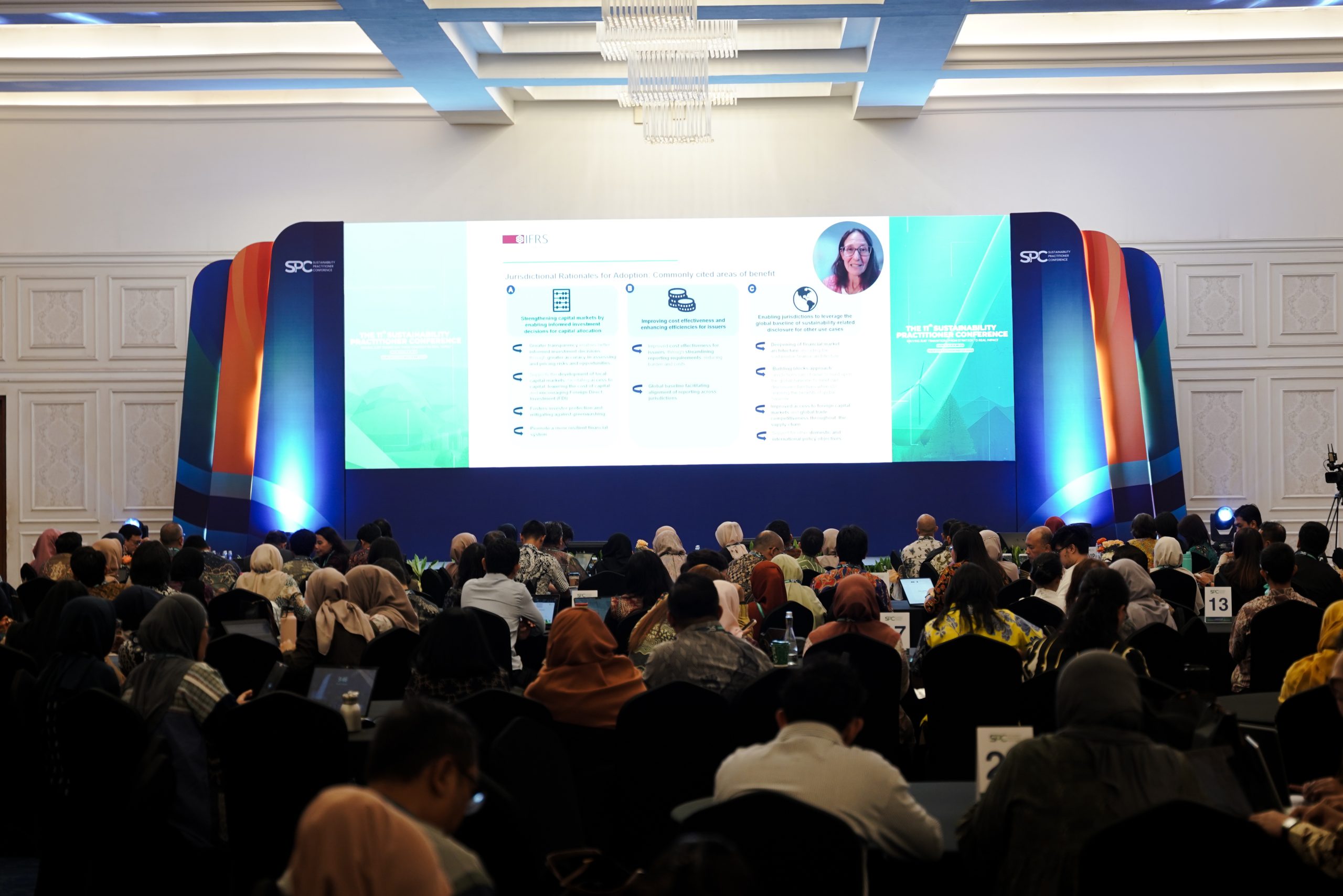
The 11th Sustainability Practitioner Conference (SPC) 2026 brought together regulators, business actors, financial institutions, and international organizations to discuss concrete steps toward a just low-carbon economy.
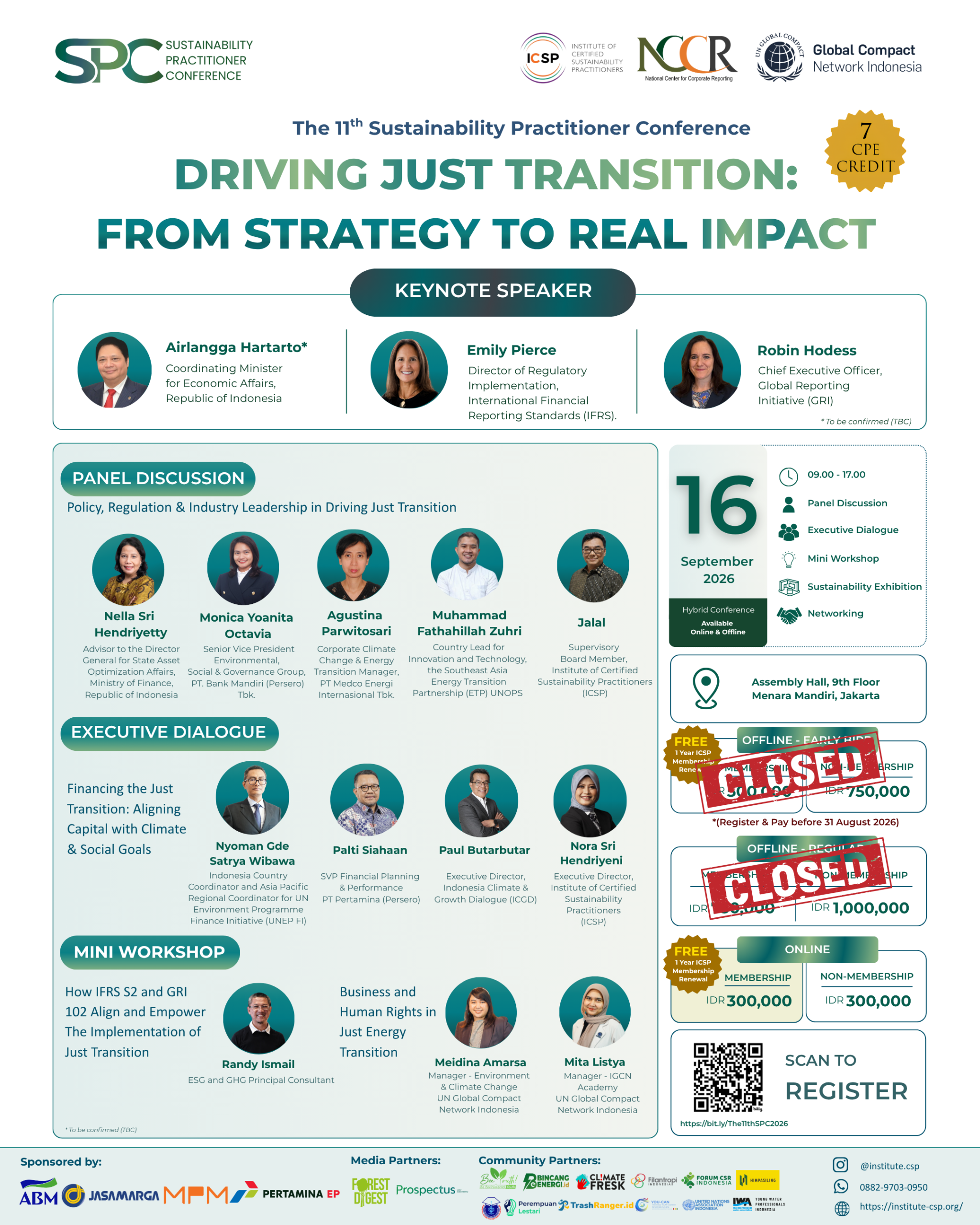
The 11th SPC 2026 was held on Wednesday, 16 September 2026, at the Assembly Hall, Menara Mandiri, Jakarta, and was broadcast in a hybrid format. Under the theme “Driving Just Transition: From Strategy to Real Impact”, the conference was organized by the Institute of Certified Sustainability Practitioners (ICSP) together with the National Center for Corporate Reporting (NCCR), with UN Global Compact Network Indonesia (IGCN) as strategic partner. The following is a summary of all agenda items at The 11th SPC 2026.
WELCOME SPEECH: FROM COMMITMENT TO IMPLEMENTATION
The opening session featured two welcome addresses that both emphasized that the low-carbon transition must not remain a commitment on paper, but must be translated into policy, investment decisions, business transformation, and tangible action.
Key Takeaways
Drawing on both addresses, the opening message of the conference rests on four interrelated points:
- A just transition as a way of managing economic transformation. A just transition is not merely an environmental program with a social aspect added at the end. It determines how fast change occurs, where capital is directed, whose perspective shapes the process, and how institutions are accountable for the results.
- The implementation gap.Many organizations have announced sustainability ambitions, but real impact depends on governance, capital allocation, credible financing, performance indicators, and reporting and assurance that stakeholders can trust.
- Interlinked crises. Climate change, geopolitical conflict, social inequality, biodiversity loss, and the food, water, and migration crises exacerbate one another. Therefore, the low-carbon transition must not focus solely on technology, investment, and emission reductions, but must also address issues affecting workers, communities, and social justice.
- Early planning and stakeholder engagement. Companies need to develop a clear, measurable, and time-bound roadmap covering emission targets, investment needs, affected workers and communities, and skills requirements. The process involves workers, trade unions, local communities, government, investors, and educational institutions through social dialogue.
KEYNOTE SPEECH: REPORTING STANDARDS AS A FOUNDATION OF TRUST
The keynote session featured two key figures in global sustainability reporting standards, who discussed how credible information underpins the transition.
Key Takeaways
Drawing on both presentations, it is evident that reporting standards serve as a foundation of trust for the transition, resting on five points:
- Globally comparable standards.The International Sustainability Standards Board (ISSB) Standards were developed to meet market demand for information that is useful for decision-making and comparable, complementing various other voluntary standards. More than 45 jurisdictions have used or are adopting them, covering more than 60% of global GDP.
- Benefits for investors, companies, and jurisdictions. In addition to helping investors allocate capital, the preparation of sustainability information helps companies identify risks and opportunities, strengthen data governance, and improve access to capital. For financial markets, better transparency supports long-term financial stability.
- Climate strategy connected to business decisions. IFRS S1 and S2 are inseparable and built on four pillars: governance, strategy, risk management, and metrics and targets. IFRS S2 requires companies to explain their climate-related risks (physical or transition), their strategic response, scenario analysis, and Scope 1, 2, and 3 emissions. The standard does not require companies to set targets or have a transition plan, but where these exist, the information must be disclosed.
- Climate transition and just transition are inseparable. The GRI 102: Climate Change standard links climate disclosure with its impacts on workers, communities, and value chains, and is designed to be interoperable with IFRS S2. Stakeholders want information that is credible, measurable, and comparable across organizations.
- Trust as a prerequisite for action. Reporting is seen as a management tool, not an end in itself. Transparency builds the trust needed to forge partnerships, attract investment, and turn ambition into measurable impact.
PANEL DISCUSSION: ‘POLICY, REGULATION & INDUSTRY LEADERSHIP IN DRIVING JUST TRANSITION’
The panel discussion brought together representatives of the Government, the banking sector, the energy industry, and an international organization to discuss how policy, reporting standards, and industry leadership can advance a just transition in Indonesia.
Key Takeaways
From the discussion, it is evident that Indonesia’s just transition ecosystem rests on six interrelated elements:
- Policy and fiscal measures. The Government sets direction through climate targets and regulations, prepares fiscal incentives, carbon economic value (NEK) rules, and social protection for affected groups. The Government’s role is not that of a sole financier, but to create conditions that encourage private and international funds to flow in. Regulations draw on global standards, but need to be adapted to the local context, because standards applied without adjustment do not fit Indonesia’s conditions.
- Investment needs far exceed available public funds, so meeting them becomes the state’s responsibility first, before discussing project bankability. A blend of funding sources is therefore needed: the state budget, international partners, multilateral development banks, banks, and investors, using instruments such as blended finance, guarantees, and sustainability-linked loans for high-emitting sectors. However, price incentives for green financing are not yet significant, so additional policy support from regulators is still needed.
- Project readiness (bankability).Capital struggles to flow because projects are not yet ready for financing, among other reasons due to the dominance of a single offtaker, long tenors, high upfront costs for new technology, transmission constraints, and immature project preparation. Risk-sharing schemes and stronger project preparation are key.
- People and regions.Decarbonization must go hand in hand with social protection and energy affordability. Coal-fired power plant workers and their supply chains need to be protected and equipped with new skills. Reskilling need not lead back to the energy sector, and local governments have a major role because regional revenues are also affected and many of residents’ expectations are in fact the responsibility of local governments.
- Transparency and reporting.Investors and markets demand transition plans, emission targets, and sustainability information that are transparent, measurable, and credible. Reporting is moving toward international standards, so governance, data, third-party assurance, and certified professionals become important so that commitments are not regarded as mere claims (transition washing).
- Collaboration and multi-stakeholder governance. One development in Indonesia is the Just Energy Transition Partnership (JETP) scheme, a partnership between the Government of Indonesia and international partners, which gave rise to a Just Transition Framework with nine standards. Eight of these ensure that no party is harmed, while the ninth (economic diversification and transformation) ensures that communities around projects also benefit. Implementation requires monitoring not only by companies but also by local and central governments, as well as partnerships for high-cost technologies and workforce training.
EXECUTIVE DIALOGUE: ‘FINANCING THE JUST TRANSITION: ALIGNING CAPITAL WITH CLIMATE & SOCIAL GOALS’
The executive dialogue brought together representatives of an international financial institution, an energy corporation, and a climate finance practitioner to discuss how financing strategies and business decisions can direct capital effectively toward a just low-carbon transition, while sustaining business performance and competitiveness.
Key Takeaways
From the discussion, it is evident that efforts to align capital with climate and social goals rest on five interrelated points:
- Consistent and coordinated policy. Indonesia’s policy framework is considered fairly comprehensive, but the challenge lies in translating it to the operational level. Harmonization among regulators, a uniform classification of sustainability activities, and a consistent long-term policy direction are needed. Sustainability reports are indeed already mandated by regulators, but the Sustainability Disclosure Standard Statements (Pernyataan Standar Pengungkapan Keberlanjutan, PSPK) 1 and 2, national standards that adopt IFRS S1 and S2, are currently still voluntary. As a result, companies prepare their own climate scenario analyses and do not yet draw on national scenarios for each industry.
- Incentives and policy signals.Non-fiscal incentives alone are not enough. Business actors are awaiting regulatory encouragement that is applied evenly, including instruments such as carbon pricing, so that low-carbon choices are economically viable and not taken up by only a handful of companies.
- Project financial viability (bankability). Low-carbon projects must still meet investment calculations, namely certainty of the buyer (offtaker), a competitive cost of funds, and minimum returns aligned between lenders and shareholders. Few projects are ready for financing, partly because of risks in the procurement process and power purchase agreements.
- The role of financial institutions and creative financing. Global principles encourage banks and insurance companies to incorporate transition risks and social dimensions into financing decisions. Funding does not always come from the Government, because carbon markets, blended finance, and combinations of banking and insurance open other sources, as long as the data and operational regulations are adequate.
- Corporate strategy and fairness for stakeholders. The transition changes companies’ portfolios, capital allocation, and human resource needs. Upskilling, efforts to minimize layoffs, and community engagement are therefore needed. Transition costs also need to be managed so that they do not make the economy too expensive.
MINI WORKSHOP: FROM PRINCIPLES TO PRACTICE
Two mini workshops closed the program with a more practical approach, namely translating just transition principles into business practice and sustainability disclosure.
Mini Workshop 1: Business and Human Rights in Just Energy Transition
This workshop discussed the energy transition from a business and human rights perspective. Companies are on both sides of the energy system, as producers that shape supply and as users that shape demand, so both carry social impacts and responsibilities in the transition. Participants learned two main references, namely the UN Guiding Principles on Business and Human Rights (UNGPs), on how companies should act, and the ILO Guidelines for a Just Transition, on what needs to be protected, including its impacts on workers and communities.
This understanding was deepened through examples of practice in various countries and a decision-making simulation that brought together decarbonization targets and the interests of the workforce and communities around projects. The session closed with an introduction to human rights due diligence, namely identifying and assessing impacts, engaging stakeholders, providing remedy mechanisms, and following up through action plans.
Mini Workshop 2: How IFRS S2 and GRI 102 Align and Empower the Implementation of Just Transition
This workshop discussed how the IFRS S2 and GRI 102: Climate Change disclosure standards can complement each other in supporting the implementation of a just transition. Participants were introduced to the differing focus of the two standards, namely IFRS S2 on financial materiality and GRI 102 on socio-economic impacts related to climate change, as well as how a just transition can be placed within a company’s governance, strategy, risk management, and metrics.
In the practical session, participants studied the steps companies can take, from calculating greenhouse gas emissions, assessing climate risks and their impacts on workers and communities, setting targets, to developing a transition plan. The discussion was enriched with examples of just transition disclosures from energy companies.
WATCH
THE 11TH SUSTAINABILITY PRACTITIONER CONFERENCE (SPC) 2026
AT ICSP’S YOUTUBE CHANNEL

FLYER
AGENDA
The 11th Sustainability Practitioner Conference (SPC) 2026
07.00-09.00 WIB
REGISTRATION
09.00-09.20 WIB
OPENING AND WELCOME REMARKS

Sylvia Veronica N.P. Siregar
Chairperson, Board of Director
Institute of Certified Sustainability Practitioners (ICSP)

Ali Darwin
Chairman, Board of Director
National Center for Corporate Reporting (NCCR)
09.20-09.50 WIB
KEYNOTE SPEECH

Airlangga Hartarto*
Coordinating Minister for Economic Affairs,
Republic of Indonesia

Emily Pierce
Director of Regulatory Implementation,
International Financial Reporting Standards (IFRS)

Robin Hodess
Chief Executive Officer,
Global Reporting Initiative (GRI)
09.50-11.30 WIB
PANEL DISCUSSION
Policy, Regulation & Industry Leadership in Driving Just Transition

Nella Sri Hendriyetty
Advisor To The Director General For State Asset Optimization Affair,
Ministry of Finance, Republic of Indonesia

Monica Yoanita Octavia
Senior Vice President Environmental, Social & Governance Group,
PT. Bank Mandiri (Persero) Tbk.

Agustina Parwitosari
Corporate Climate Change & Energy Transition Manager,
PT Medco Energi Internasional Tbk.

Muhammad Fathahillah Zuhri
Country Lead for Innovation and Technology,
the Southeast Asia Energy Transition Partnership (ETP), United Nations Office for Project Services (UNOPS)

Moderator
Jalal
Supervisory Board Member,
Institute of Certified Sustainability Practitioners (ICSP)
11.30-13.00 WIB
BREAK AND OPEN NETWORKING
13.00-14.30 WIB
EXECUTIVE DIALOGUE
Financing the Just Transition: Aligning Capital with Climate & Social Goals

Nyoman Gde Satrya Wibawa
Indonesia Country Coordinator and Asia Pacific Regional Coordinator
UN Environment Programme Finance Initiative (UNEP FI)
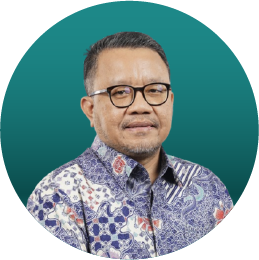
Palti Siahaan
SVP Financial Planning & Performance
PT Pertamina (Persero)

Paul Butarbutar
Executive Director,
Indonesia Climate & Growth Dialogue (ICCD)

Moderator
Nora Sri Hendriyeni
Executive Director
Institute of Certified Sustainability Practitioners (ICSP)
14.30-15.30 WIB
MINI WORKSHOP
Businesss and Human Rights in Just Energy Transition

Meidina Amarsa
Manager Environment & Climate Change,
UN Global Compact Network Indonesia (IGCN)

Mita Listya
Manager IGCN Academy,
UN Global Compact Network Indonesia (IGCN)
15.30-15.45 WIB
COFFEE BREAK
15.45-16.45 WIB
MINI WORKSHOP
How IFRS S2 and GRI 102 Align and Empower the Implementation of Just Transition

Randy Ismail
ESG and GHG Principal Consultant
VENUE LOCATION
HOSTED BY


OUR STRATEGIC PARTNER
OUR SPONSORS



OUR COMMUNITY PARTNERS










OUR MEDIA PARTNERS


BE PART OF SPC
Become a
Sponsor
Gain visibility, connect with sustainability leaders, and demonstrate your commitment to a just and sustainable future.
For inquiries, contact:
[email protected]
Become a
Community Partner
Mobilize your community, co-promote the event, and access complimentary passes for your members.
For inquiries, contact:
[email protected]
Become a
Media Partner
Extend your reach, cover the conversations that matter, and be part of Indonesia’s leading sustainability conference as an official media partner.
For inquiries, contact:
[email protected]