Getting to Know CBAM
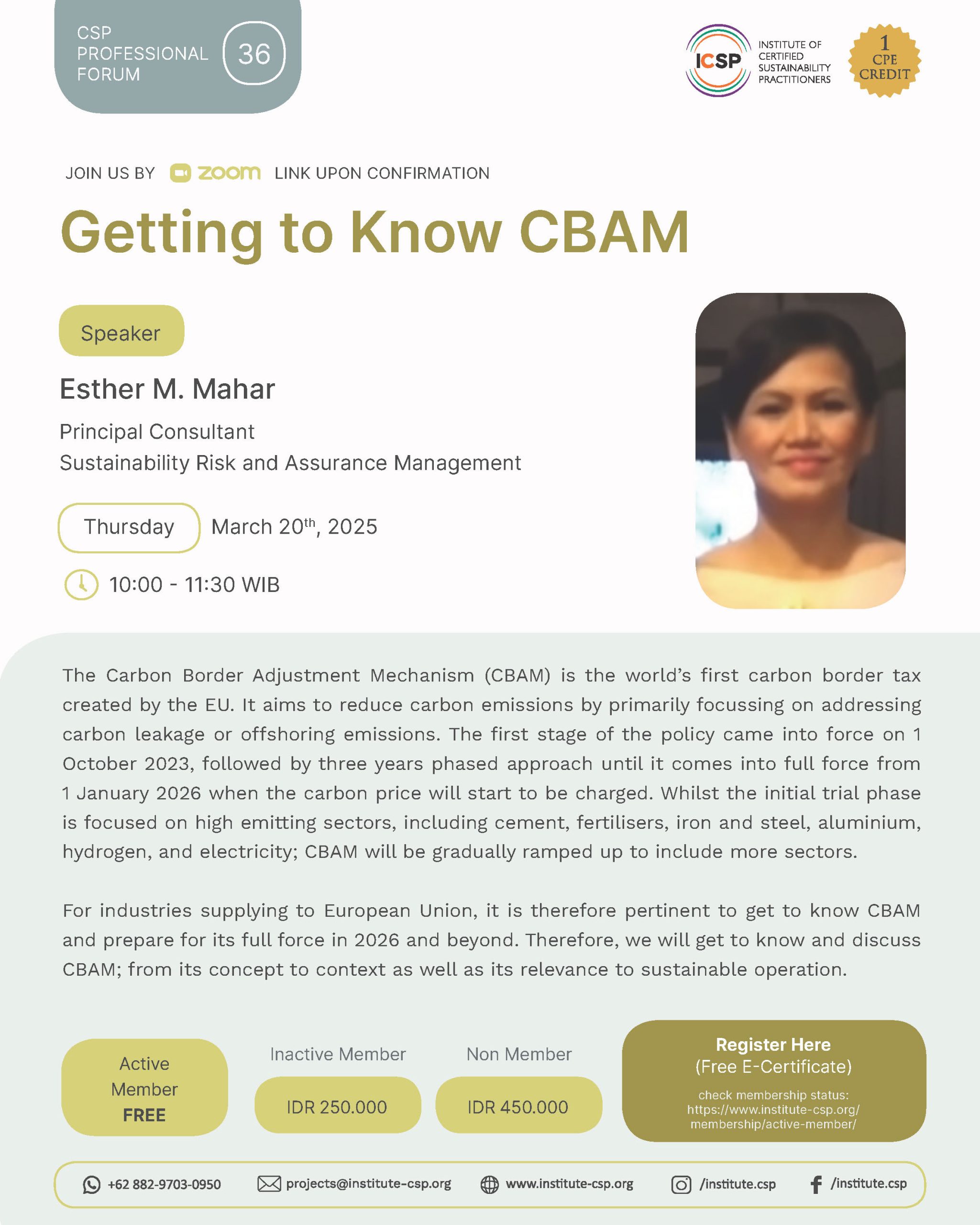

The Carbon Border Adjustment Mechanism (CBAM) is the world’s first carbon border tax created by the EU. It aims to reduce carbon emissions by primarily focussing on addressing carbon leakage or offshoring emissions. The first stage of the policy came into force on 1 October 2023, followed by three years phased approach until it comes into full force from 1 January 2026 when the carbon price will start to be charged. Whilst the initial trial phase is focused on high emitting sectors, including cement, fertilisers, iron and steel, aluminium, hydrogen, and electricity; CBAM will be gradually ramped up to include more sectors.

For industries supplying to European Union, it is therefore pertinent to get to know CBAM and prepare for its full force in 2026 and beyond. Therefore, we will get to know and discuss CBAM; from its concept to context as well as its relevance to sustainable operation.


Registration For

Personal Information

Membership Information

Payment Information

Perkumpulan Praktisi Keberlanjutan Bersertifikat
Bank Name : Bank Central Asia
KCP: Arkadia Jakarta
Account Number : 540-5202911
Account Address : Gd. Kantor Hijau Arkadia Tower F-GF
Jl. TB. Simatupang Kav. 88 Jakarta 12520
NPWP: 83.525.116.6-016.000

Hourly Schedule

Day 1

10.00 - 11.30

Date

Mar 20 2025
Expired!

Time

10:00 am - 11:30 am

Location

Jakarta
Jakarta, Indonesia

Category

Comments are closed here.

Institute of Certified Sustainability Practitioners (ICSP) is an organization for Sustainability Practitioners. Established to educate professionals preserving natural and social capital resources by using principle professional guidelines.

Learn More

  PARTNERS

The National Center for Corporate Reporting (NCCR), formerly known as the National Center for Sustainability Reporting (NCSR), was established in 2005 through the initiative of government bodies, corporations, and distinguished individuals who recognized early on the importance of developing sustainability competencies in Indonesia.

In 2007, the Government of Indonesia introduced regulatory requirements for certain private and public corporations to undertake sustainability initiatives and disclose their sustainability performance. This regulatory development further strengthened the relevance of NCCR’s role in advancing sustainability reporting practices in the country.

Since its establishment, NCCR has continuously aligned its programs with global sustainability developments. It is recognized as a GRI Certified Training Partner and GRI Data Partner, demonstrating its commitment to internationally accepted sustainability reporting standards.NCCR has also organized the Indonesia Sustainability Reporting Awards annually since 2005, which is now known as the Asia Sustainability Reporting Rating (ASRRAT), serving as a platform to promote transparency, accountability, and excellence in sustainability reporting.

If you have further question, please do not hesitate to contact us.